
MGM Television
Today marks twenty years since Stargate Atlantis made its debut. (Yes — like me, you really are that old!) The series premiere, “Rising,” aired as a 2-hour movie on July 16, 2004.
It was what many of us consider to be a Golden Age of science fiction television, with SCI FI Channel (back before its 2009 rebranding to “Syfy”) owning Friday nights with its block of original programming. Stargate SG-1 would air at 8 p.m., followed immediately by its new spin-off the next hour. Six months later the remake of Battlestar Galactica would join them, at 10 p.m.
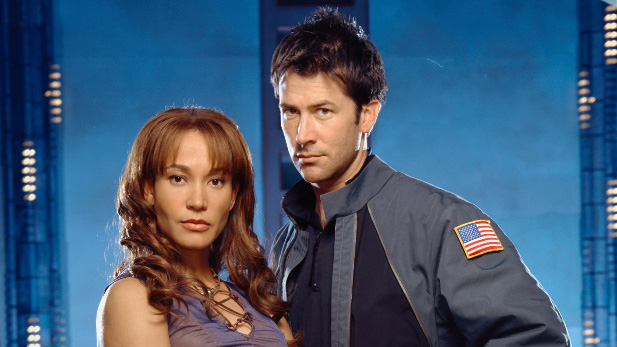
On this day two decades ago we met Joe Flanigan’s Major John Sheppard, described on paper as a bit like Jack O’Neill (in his swagger and his acerbic humor) but stuck flying helicopters at a remote post in Antarctica after he defied orders. We met his new commanding officer in Atlantis in Colonel Marshall Sumner (though by the time the night was over it was clear that actor Robert Patrick was a guest star and not an ongoing member of the new cast). We met the young Lt. Aiden Ford, played with great enthusiasm by Rainbow Sun Francks; and Teyla Emmagan, Rachel Luttrell’s alien princess who joins the new team to protect her people.
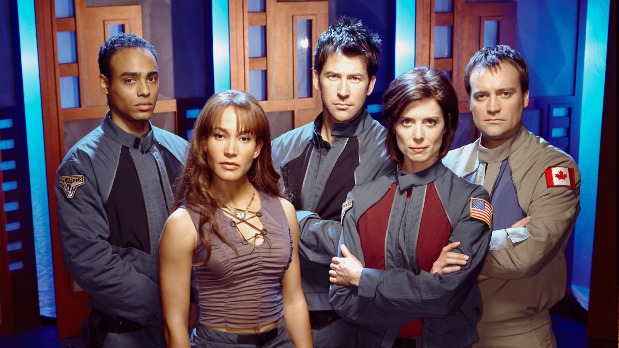
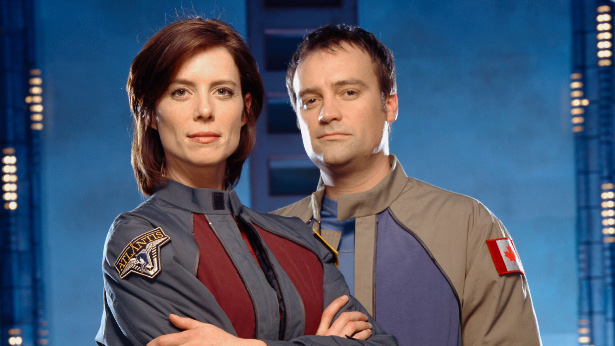
Of course viewers of Stargate SG-1 already knew Dr. McKay (who now got his first name, Rodney … actually revealed later to be Meredith’s middle name). Actor David Hewlett had gotten under our skin in the episode “48 Hours,” then returned with some softer edges to his memorable character in “Redemption.” Could this arrogant, know-it-all science jerk really be fun to watch week in and week out? (Hewlett, and the show’s writers, were about to turn McKay into one of the show’s most popular characters.)
And finally, if you tuned in for the 2-hour premiere of SG-1 the previous week you already knew Torri Higginson, who had taken over the role of Elizabeth Weir — played by Jessica Steen in the seventh season finale, “Lost City.” (Steen only recently revealed why she did not continue in the role.) Dr. Weir was a civilian diplomat, tapped to lead an international expedition of scientists and military personnel through the Stargate to the lost city of the Ancients — the race who built the Stargate network many thousands of years ago.
It was a brand new take on Stargate.
A SCI-FI EVENT
The premiere of Stargate Atlantis was a real event for the young cable channel. SCI FI had dipped its toes into original programming in the late 1990s, with international acquisitions like First Wave and Lexx, off-network pickups like FOX’s cancelled Sliders, and new original dramas such as Farscape.
Acquiring the basic cable rights to Stargate SG-1 proved to be a boon for SCI FI, and new viewers (who didn’t subscribe to Showtime) had the chance to rapidly catch up on five seasons of great science fiction with episodes aired in a Monday through Friday strip format. By 2002 the show had moved to SCI FI as its home for new episodes as well, helping to boost the channel to a top 10 cable network for the first time. Two successful seasons later and it was a certainty that MGM and SCI FI were ready to expand the franchise.
But Stargate Atlantis wouldn’t just be a successor to SG-1. It would also air alongside its parent show, which was also renewed for its eighth year. This prompted some creative revisions for the writers, who had planned to reveal the location of Atlantis on Earth itself. The city would become Earth’s new international base for gate travel, as SG-1 moved on to what Atlantis co-creators Brad Wright and Robert C. Cooper hoped would be a series of theatrical movies.
Running the two shows together meant that Atlantis was off to another galaxy instead, and for at least the first season the expedition was cut-off from Earth (so that they couldn’t call for reinforcements or bring in SG-1 when things got tough). This created a sense of daring that SG teams never really faced: the expedition stepped through the Stargate knowing that they might never be able to come home again. The inability to dial Earth immediately gave the show stakes, mixing a sense of wonder and adventure with the emotion of being stranded far from home.
One key element of the original plan for the spin-off did stick, though: Atlantis would have a large cast of supporting players representing many different nations. This wasn’t an extension of the U.S. military’s adventures through the Stargate, but a show that was truly written for the whole world — a Scottish doctor, Czech and Canadian and British scientists, German and Australian soldiers, and Japanese medical personnel. Fans spent that first week spotting flags on the uniforms, from Belgium and Sweden to Russia, Zimbabwe, and South Africa.
Producing a second show also proved to be a mountainous task behind the scenes — 40 hours of television every 12 months. While there were new writers and crew hired to help with the load (which was nearly double the old episode count of 22) the studio’s goal was to save costs by sharing as much as possible between the two series, which now filmed on adjoining sound stages at The Bridge Studios in Vancouver, British Columbia. (Atlantis was on Stage 6.) It ended up being a whole lot of work, which co-creator Brad Wright was lamenting three years later as SG-1 was coming to an end.
Atlantis took its first bow on July 16 with a 2-hour event, “Rising.” In an era before streaming and the wide proliferation of DVRs, SG-1 had been enjoying weekly Nielsen ratings around the 1.8 to 2.0 mark — a solid 2 million viewers every Friday, making it SCI FI’s top performer by far. The new season premiere had made waves by logging a new record one week earlier, with a 2.4. How would Atlantis fare?
While the show was riding the name recognition of a popular franchise, it was a different take on Stargate with a cast of newcomers. How many of SG-1’s fans would come along for the ride? Would they watch a Stargate show without Richard Dean Anderson? Cooper was optimistic about what they were creating, and told his fellow producers that he wouldn’t be happy with any rating less than a 3.0.
“Rising” earned a 3.2 — a new record for SCI FI Channel.
Viewers old and new were ready to meet a new team and get caught up in a new adventure, with a brand new enemy in the Wraith and new allies in a distant galaxy. The first season of the show averaged an impressive 2.27 rating (even higher than its lead-in). With two shows in production Stargate was now a bona fide franchise.
LASTING LEGACY
It all started from that first adventure: John Sheppard’s recruitment into the Atlantis expedition, the discovery of a city under water, meeting the Athosians, inadvertently waking up the Wraith, and losing some good people to this terrifying new threat. The city of the Ancients burst forth onto the surface of the ocean (to composer Joel Goldmsith’s rousing score), and both the expedition and viewers alike were ready for new weekly adventures through the Stargate.
(And the chevrons were blue!)
Stargate Atlantis went on to run for five great seasons. While the show did end prematurely it was a hell of a ride, with 100 episodes that continued to build Stargate’s mythology while bringing in new viewers and establishing a loyal fan base of its own. Those stories are ours now, to watch again and again and to share with others.
The story of Atlantis‘s 5-year run is for another time, though (read this reflection marking the fifteenth anniversary of the show’s finale). Today we celebrate the show’s beginning, especially its pilot, and the cast and crew who made it such a special series.
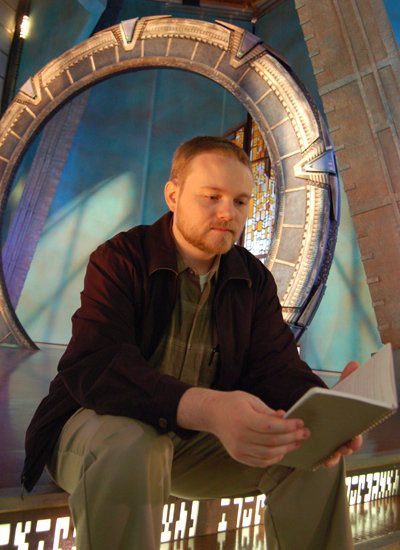
Atlantis is especially close to my own heart. In 2004 I was a cub reporter with a fan site, and MGM invited me to visit the Vancouver set in April — fully three months before the show premiered. I marveled at the expansive Gate Room (nicknamed the “Gaterium”), watched scenes being filmed (when Jinto radios in after going missing in “Hide and Seek”), and chatted with David Hewlett about Web nerd stuff in the lunch tent. It was fantastic.
After an experience like this of course I was beyond excited for the show’s big premiere. There on my TV were the same sets I had stood on, the actors who had welcomed me into their workplace to talk Stargate, finished scenes I had watched come together from one take to the next. Sure, watching Stargate would never be the same again after the fourth wall was broken — but it was worth it.
Even better than visiting the set? The show itself. Stargate Atlantis grew and expanded the world of Stargate so much farther than I imagined when I started watching SG-1 in 1998. New ideas, new heroes, new threats … it was on this day, twenty years ago today, that Stargate went from just being my favorite TV show to being such a big part of my life.
So happy birthday to John and Elizabeth, to Rodney and Teyla and Carson, Woolsey, Caldwell, Aiden and Ronon and Radek and Lorne and Hermiod — yeah, even you Kavanagh. Let’s watch it all again from the beginning.

Were you watching Stargate Atlantis on this day in 2004, or did you discover the show later? Share your first memories of the show in the comments!