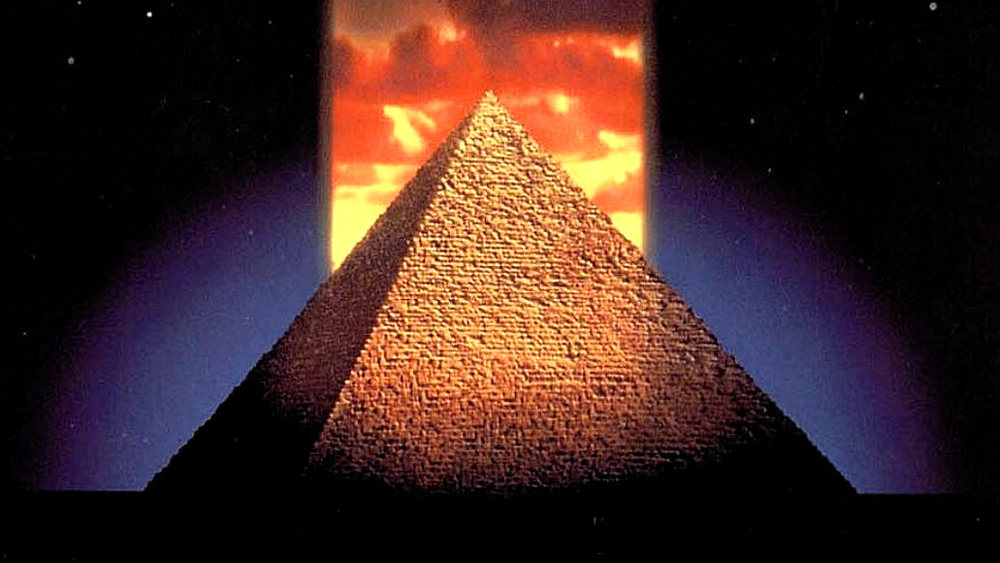
This is a revised and expanded version of a piece originally published for Stargate’s 25th anniversary in 2019.
It has been 30 years since the theatrical premiere of one of our favorite science fiction films of all time.
Stargate starred Kurt Russell and James Spader in a popcorn action flick with some notably heartfelt beats. It combined the feel of Star Wars and Indiana Jones with Lawrence of Arabia, mashing together space ships and alien weaponry with ancient Egyptian mythology, the real-world military, and a sweeping desert landscape.
German filmmaker Roland Emmerich directed the script that he co-wrote with producer Dean Devlin, and while the movie achieved some significant success in its October release window it was better received by audiences than by critics. Roger Ebert gave the film one paltry star, rolling his eyes at the film’s militarism and old-school adventure tropes, and saying that the movie about a portal to the other side of the known universe lacked any sense of wonder. The Los Angeles Times‘ Peter Rainer said, “It may be a lousy movie, but it’s a more enjoyably lousy movie than most.”
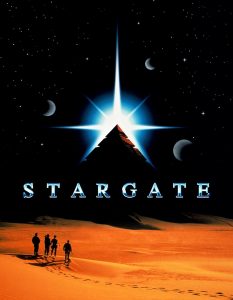
Stargate premiered in theaters on October 28, 1994.
Stargate was the quintessential ’90s action movie, pairing a square-jawed hero (a la Universal Soldier, Emmerich’s previous picture) with an awkward scientist. Russell played Colonel Jack O’Neil, a burned-out special ops soldier recalled to active duty because his superiors knew he would be prepared to sacrifice his life for one last mission. James Spader was Dr. Daniel Jackson, a down-on-his-luck Egyptologist laughed out of the academy (literally) because of his controversial theories about the true origins of the pyramids.
The brilliant Holger Gross worked as Stargate‘s production designer, with Joseph Porro supervising the elaborate costume department. Patrick Tatopoulos came on board to lead the creature effects team (the iconic Mastadge being a combination of animatronics, a Clydesdale horse, and a small dog filmed at a distance). And the movie’s ambitious visual effects were supervised by Jeff Okun.
David Arnold scored the picture. His sweeping, cinematic score is still highly listenable today (check out the new 25th anniversary edition of the soundtrack). For years the film’s music was frequently heard as a temp track on the trailers for other movies.
Stargate premiered on October 28, 1994, and was a surprise hit. With a production budget of $55 million, the film made $71.5 million in the U.S. and $196.5 million at the worldwide box office. (That’s a healthy $415 million in today’s dollars.) Stargate opened at #1 on the box office charts in a relatively quiet week, against the likes of Pulp Fiction (in its third week of release), Sylvester Stallone’s The Specialist (in its fourth week), and The Road to Wellville.
Thirty years later, Stargate has a rich legacy of storytelling thanks in large part to its three TV spin-offs. But for fans of the original, the film’s anniversary also stands as a marker of a missed opportunity — a very different take on Stargate that never came to be.
What did Emmerich and Devlin intend to do with a sequel? Was there a connection to their next film, 1996’s Independence Day? And how did Stargate’s creators lose control … leading to a massively successful television franchise that today spans more than 350 hours?
Facebook | Roland Emmerich
REACHING THE SILVER SCREEN
“StarGate” went before cameras in 1993. This was to be Lawrence of Arabia on another planet, in Devlin’s words. To make that dream a reality filming took place in the sand dunes outside Yuma, Arizona — under the July heat, in order to avoid the busy dune buggy season. (A team of 30 was hired to sweep the sand with massive brooms in between takes, in order to remove cast and crew footprints.)
The massive entrance to the Abydos pyramid emerged out of the desert floor and stood eight stories high. Construction took place overnight and in the early morning hours. Some filming took place at night, with lights brought in to masquerade as daylight hours.
The film’s production employed some 1,200 extras for the crowd scenes, but faced high attrition: after experiencing the 126-degree heat first-hand, many did not return to work the next day.
Elsewhere, sets for the indoor scenes — the Air Force missile silo and Ra’s pyramid fortress — were more ambitious than the producers could fit into any available sound stage. And so Stargate rented out the massive hangar that once housed Howard Hughes’ Spruce Goose, and built the sets there. The 135,000 square-foot dome in Long Beach, California was the largest in the world.
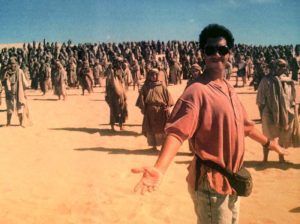
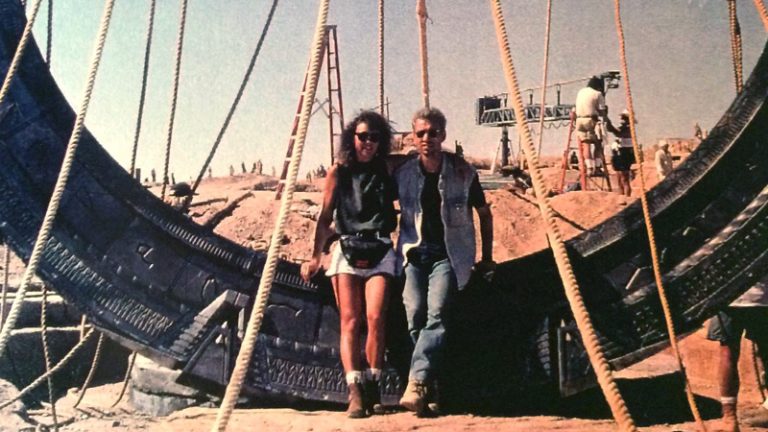
Dean Devlin on location in the Yuma desert. (Facebook | Roland Emmerich)
Emmerich was coming off 1992’s Universal Soldier, which starred Jean-Claude Van Damme and made a modest $36 million (domestic). Since the early 1980s Emmerich had been toying with the idea of a story connecting the ancient Egyptian pyramids with alien space ships, with a bit of inspiration from Erich von Däniken’s book Chariot of the Gods?. This idea resonated with his new creative partner Dean Devlin when the two met later that decade. Devlin was a young actor in 80s, and was cast in Emmerich’s 1990 sci-fi flick Moon 44. Then he turned to writing, and Universal Soldier became his first credited writing job.
Devlin was also a lover of science fiction, and by the early 1990s the two were actively collaborating on Stargate.
“As we were looking at projects to do, he kept telling me about a project that he had been working on since he was in film school called Necropol,” Devlin told “Dial the Gate.” “And what it was about was a space ship that was buried under the Great Pyramid of Giza … but he’d never really fleshed it out. … And I had been working on something that was very rough in my head that I would jokingly call ‘Lawrence of Arabia in Outer Space!’ It was a good guy / bad guy who were chasing each other in space, and they go thorough a wormhole but the good guy hesitates for 5 seconds before he follows him in — but those 5 seconds end up being 30 years on the other side when he lands. And by then the villain has taken over this other world.”
“We said, maybe there’s some way to connect these together and turn it into one project.” Instead of time travel, and instead of a story set on Earth, production designer Oliver Scholl turned them on to the trope of a teleportation device — which became the point of connection they needed between the two ideas: the Stargate.
France’s pay-TV giant Le Studio Canal+ and the big-budget hit maker Carolco Pictures would produce the film, along with Devlin and Emmerich’s Centropolis Film Productions. (MGM, which today owns the franchise, was not yet in the picture.) It was Devlin’s first producer credit (he was 31 when the movie was shooting), and the sixth picture from Centropolis. The team managed a somewhat Herculean feat, gathering multiple financiers from various countries to pay for Stargate‘s production.
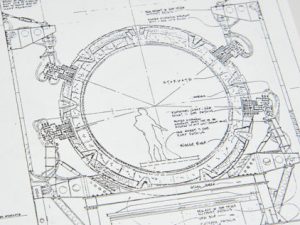
An original sketch of the Stargate, circa 1993. (Earlier sketches started with a triangular gate.) From the estate of Holger Gross.
Getting the picture distributed worldwide, on the other hand, was a different matter. Their picture had been shot independent of any of the major studios, and without a U.S. distribution deal in place. Now Emmerich and Devlin would need to find new partners to make sure their project actually found an audience.
“Every single studio in Hollywood rejected it,” Devlin told Forbes in 2018. “They all said that science fiction is dead and nobody cared about sci-fi anymore. We found out that MGM had a hole in their distribution schedule; they had no films to release for a couple of months, and so we convinced them to release Stargate.
“They didn’t believe in the movie and they didn’t really want to put any money behind it, so I spent a year going to every sci-fi convention in the country. We invented the first movie Web site because the Internet was pretty new and no one had done that before.”
Along with Devlin’s on-the-ground promotion efforts, word of mouth helped the movie to become a kind of grassroots hit. The picture defied some pretty widespread expectations that it would be a dud at the box office. Instead, Stargate opened in first place and made $196 million.

CUTTHROAT DECISIONS
Striking a distribution deal with MGM in February of 1994 proved to be a double-edged sword. The studio was an investor in the now struggling Carolco Pictures (founded by Andrew G. Vajna and Stargate executive producer Mario Kassar). MGM also distributed some of Carolco’s films in the United States. Stargate would have its time in the spotlight — but before the film opened Carolco, short on cash, had to sell off some of its assets to help finance its next project: Cutthroat Island.
With a budget near $100 million, Cutthroat Island starred Geena Davis and Matthew Modine (after Michael Douglas dropped out). Carolco had succeeded with some blockbusters over the years, but now the company was facing bankruptcy. It needed another hit to stay afloat. Financing the production of that picture included letting Stargate go to MGM in 1994 … as part of Carolco’s last-ditch effort to save the company.
Co-financier StudioCanal was also getting cold feet. “The week before the movie opened the people who had financed the movie, which was a group out of France, were so sure that they had a bomb they sold the movie to MGM for $5 million,” Devlin revealed. “So then, MGM owned the movie.”
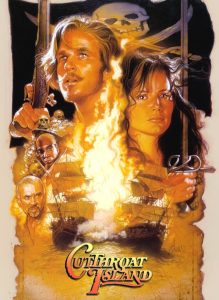
Carolco’s investment in Cutthroat Island (1995) played a significant part in Stargate’s move to television.
Carolco had bet its future on Cutthroat Island. Cameras rolled the very same week that Stargate hit theaters, but by 1995 “the company was dead,” as star Geena Davis put it to The New York Times. “Everyone knew that one way or another, this was their last movie.”
The pirate pic flopped hard with a box office of just $10 million — leaving Stargate in the hands of MGM, and Carolco in bankruptcy by the fall of 1995. Other Carolco assets to be auctioned off included Rambo, Total Recall, Universal Soldier, and Terminator.
But Metro-Goldwyn-Mayer now owned Stargate.
ONE AND DONE
Stargate premiered in 1994 with the biggest fall opening ever, and Roland Emmerich and Dean Devlin knew they had a hit on their hands. The brand was strong, and ripe for more stories. Like Star Wars and Star Trek in the previous decade and a half, Stargate just might be the next big-screen science fiction franchise.
Emmerich and Devlin wanted to make a trilogy of Stargate movies. That’s a fact they were not quiet about in 1994 and 1995, and certainly not in the years that followed.
“When we created the original Stargate, we always envisioned it as a trilogy, and, unfortunately, the way in which the movie got made, we didn’t really have control over [it],” Devlin told SciFi Wire in 2006. “We didn’t have the ability to do [films] two and three. MGM had then made a big commitment to doing the [SG-1] series, and they were worried that the movie could interfere with the series.”
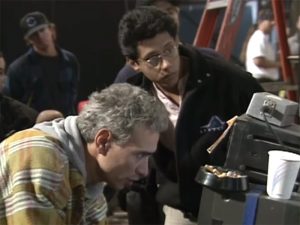
Director Roland Emmerich and producer Dean Devlin on the set of 1994’s Stargate.
“Roland and I went in to meet with them to talk about the series, and they said, ‘Oh, we don’t really want you guys involved,’” Devlin told “Dial the Gate.” “It was a very painful thing for a long time, because you’re watching someone else raise your children. It was very hard.”
With the first television series nearing its end, Devlin at that time hoped that the studio would be willing to go back to the big screen. But with a still thriving television universe in production by way of spin-offs, it wasn’t going to happen.
In the years since, Devlin has hinted at the path their story would have taken after O’Neil’s return to Earth at the end of the film. Were there actually more aliens out there — others of Ra’s species, or other extra terrestrial civilizations? A second film would have moved beyond ancient Egypt to explore an entirely different mythology, with Daniel Jackson returning to Earth to discover a second gate 12 years after the events of the first film.
“We wanted to explore the idea of how the Stargates were built originally, and where else in the universe they exist, and why they exist — and where else they exist on Earth,” Devlin told Collider in 2011. “We had really planned out, as a trilogy of films, to allow this mythology to grow bigger and bigger.”
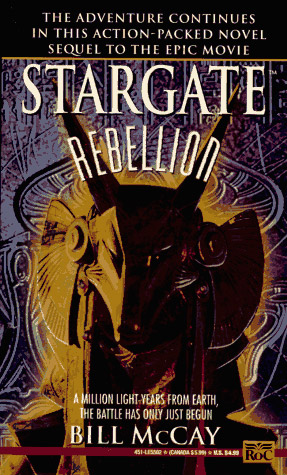
Bill McCay’s “Stargate Rebellion” was the first of five novels that predate the television series.
“There are two different places on Earth that are famous for pyramids,” he told “Dial the Gate” in 2020. “And one was an Egyptian, and our second was going to be a Mayan culture. And then the third was going to tie in almost every mystery that we’ve ever had on Earth! Whether it was Bigfoot, or the Yeti — we were going to tie everything together into a larger mythology. And it was going to be so much fun. It was going to be so wild. But we never got to go there. We never got to explore it.”
Perhaps the closest audiences got to that story was the series of five novels by Bill McCay, published between 1995 and 1999. In McCay’s story (supposedly developed using some of Emmerich’s own notes), Ra’s mythological queen Hathor arrives on Abydos following his destruction, wreaking havoc and bringing about a devastating war that sets Hathor’s ship on a course for Earth.
“We worked with him on those original ones, and I’m real proud of those and I support those entirely,” Devlin said. He considers the books to be a canonical extension of the film universe, stories that could have been folded into the film trilogy.
It is an interesting thought experiment to imagine how a theatrical sequel to Stargate, circa 1998, might have looked. But it was not to be. By 1996 MGM had decided to take the brand to television instead.
MOVING ON
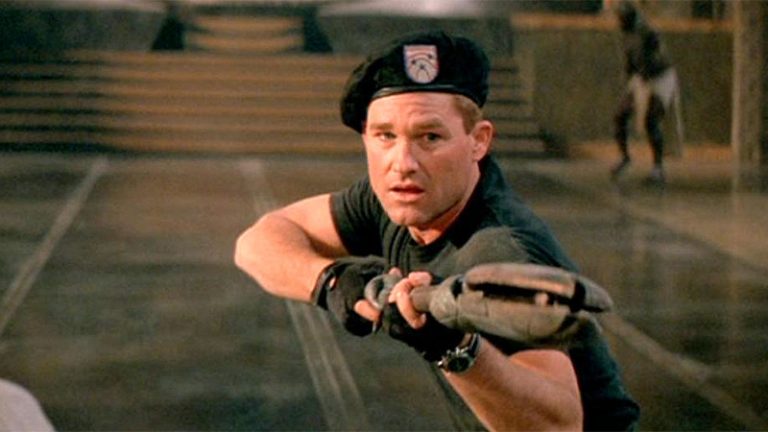
Kurt Russell’s credits after Stargate included the likes of Escape from L.A. (1996), Soldier (1998), and 3000 Miles to Graceland (2001). Coincidentally, production on the latter brought him to The Bridge Studios in Vancouver, where he paid a visit to the set of Stargate SG-1. There is no reason to think Russell wouldn’t have been up for a Stargate sequel: in 1994 his paycheck for the first film — a reported $7 million — made headlines, and raised a few eyebrows (as Carolco was earning a reputation for paying big sums for marquee talent).
After another sci-fi flick in 2000’s Supernova, James Spader moved to television with six years as Alan Shore on The Practice and Boston Legal. And he looked back on Stargate as just a job.
“The script was just awful, and that sort of intrigued me,” Spader told Entertainment Weekly. “That made me want to meet the director, and then he got me excited about it. … I realized that making this picture (which was filmed largely in the Arizona desert) was going to be such an adventure that out of that would come an adventure on screen.
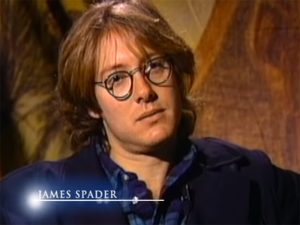
James Spader was reluctant to do the picture, but was motivated by the money and convinced by the director’s enthusiasm.
“Acting, for me, is a passion, but it’s also a job, and I’ve always approached it as such. I have a certain manual-labourist view of acting. There’s no shame in taking a film because you need some f—ing money.”
Meanwhile the movie’s villain, Jaye Davidson, came to Stargate after making a name for himself in Neil Jordan’s The Crying Game (for which he received an Academy Award nomination). But he didn’t much like the limelight, and it is rumored that he asked for $1 million to appear in Stargate because he thought it was an outrageous number that would make the producers look for someone else — only to have them agree to it.
Davidson reportedly struggled with substance abuse throughout the film’s production, playing a character originally scripted to be an intermediary between the remote alien power and its human slaves. “He was having a hard time remembering his lines,” Devlin said. “We had these giant cue cards, but he couldn’t read them.” The dailies were not inspiring … but Devlin hit on a solution after filming had ended.
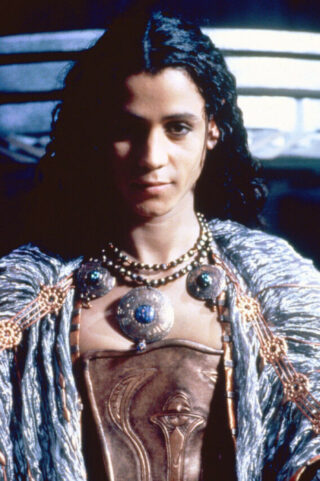
Jaye Davidson as Ra
“We shot the movie, and it didn’t work, and he didn’t work,” Devlin recalls. “It was bad casting. It just wasn’t right. And I’ll never forget, Roland and I were in a car together lamenting that our whole movie was falling apart because our villain was not working. And then I turned to Roland and I said, ‘Wait a minute, Roland … Ra doesn’t work for the aliens. He is an alien!” They added a single day of reshoots, and Ra’s glowing eyes and flanged voice were added in post-production. Suddenly, the performance worked.
By the film’s premiere Davidson was at a different place in his life, and “he saw the picture and he came to me with tears in his eyes, and he said, ‘You saved me. I thought I had ruined the picture.’ He loved the change that we had done.” Devlin said that Davidson was grateful that they had not cut him out of the movie entirely. “At that point, he had been sober for a little bit. He was really trying to put his life together.” Shortly after Stargate‘s 1994 release, Davidson quit acting and returned to the world of fashion.
Emmerich and Devlin followed Stargate with 1996’s Independence Day — their first real smash hit, taking in $306 million domestic and $817 million worldwide. It is a common misconception that the film was meant to be Stargate‘s sequel: Ra’s species comes to Earth to exact revenge for what transpired on Abydos, with Spader’s Daniel Jackson recast as Jeff Goldblum’s David Levinson. In reality, that film was already well underway (pre-production began in February 1995, and the film was shooting by July) when MGM executives decided to take Stargate to television instead.
“That’s one of the myths out there,” Emmerich wrote in 2016. “There’s no overlap between those two worlds.”
GATING TO TELEVISION
With nearly $200 million worth of success at the box office, MGM had a surprise hit — and an instant audience that was ready for more sci-fi adventures. But Devlin and Emmerich’s hopes for more movies would not come to fruition.
At the same time that Stargate was setting box office records MGM was also seeing success in original scripted television. And in 1996 two producers from their sci-fi anthology show The Outer Limits approached the studio about Stargate. Brad Wright and Jonathan Glassner hadn’t talked with each other yet; but they loved the movie and recognized the potential of this new property that MGM had picked up.
Executives at MGM paired the two producers together to create Stargate SG-1, eventually selling the series to the premium cable service Showtime. The network was looking to make a big commitment, building out a science fiction programming block for Friday nights. Showtime ordered two seasons (44 episodes) right off the bat; before SG-1 aired its first episode, they ordered two more.
Stargate’s original creators refused to participate in the project, apparently turning down consulting jobs after the creative reigns had already been handed to Glassner and Wright. When they later recorded an audio commentary for the movie’s DVD release, Devlin and Emmerich went out of their way to make it clear to the audience that they had nothing to do with the show.
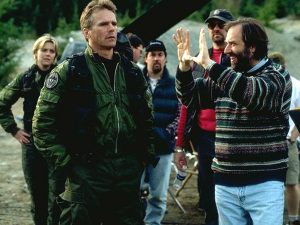
Mario Azzopardi (right) directs Richard Dean Anderson in the SG-1 pilot, “Children of the Gods.”
Stargate SG-1‘s television premiere came in 1997 — less than three years after the film’s theatrical debut. While the story picks up one year after the movie, this was clearly a reboot. Not only were the lead roles recast with TV actors, but Wright and Glassner also made adjustments to the mythology they inherited.
In the 2-hour premiere episode, “Children of the Gods,” the Stargate is in mothballs at the bottom of a military installation deep inside Cheyenne Mountain (not Creek Mountain, as in the movie — but that’s a detail for us nitpickers). O’Neill is living in retirement, and Daniel Jackson is alive and well and living on Abydos. When the gate activates and an alien who looks a lot like Ra steps through, O’Neill is reactivated to finish the mission he’d thought was a success.
There are a few changes — some subtle (Sha’uri becomes the easier-to-pronounce “Sha’re”) and some not so subtle (Ra’s species is not extinct but thriving, and they don’t look like Roswell Greys). But the move to a weekly, serialized format worked. And it made a lot of sense: the Stargate has 39 symbols on it, with millions of possible combinations. It’s only logical that one gate can go to many different places.
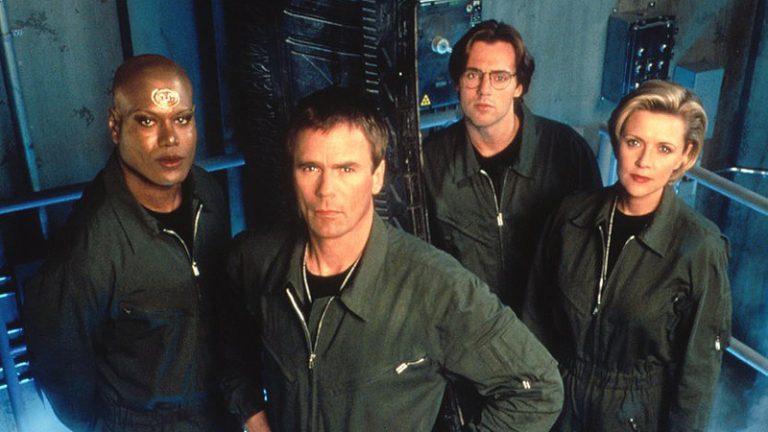
MGM’s John Symes recruited Richard Dean Anderson for the lead. Anderson brought his own fan base from MacGyver and the short-lived UPN series Legend, while Michael Shanks captured Spader’s mannerisms with a spot-on Daniel Jackson. And audiences quickly fell in love with the brilliant Captain Samantha Carter (Amanda Tapping), the comedically stoic and honorable alien warrior Teal’c (Christopher Judge), and the strong but compassionate General George Hammond (Don S. Davis).
Stargate on television became a major hit, running for 10 years and airing in over a hundred countries around the world. It spawned two live-action spin-offs after moving from Showtime to Syfy (then SCI FI Channel) in 2002, plus a pair of direct-to-DVD movies — and an often forgotten animated series. Although the 1994 movie started it all, it might be fair to say that today most people associate Stargate with Richard Dean Anderson and the television franchise.
STARGATE’S LEGACY
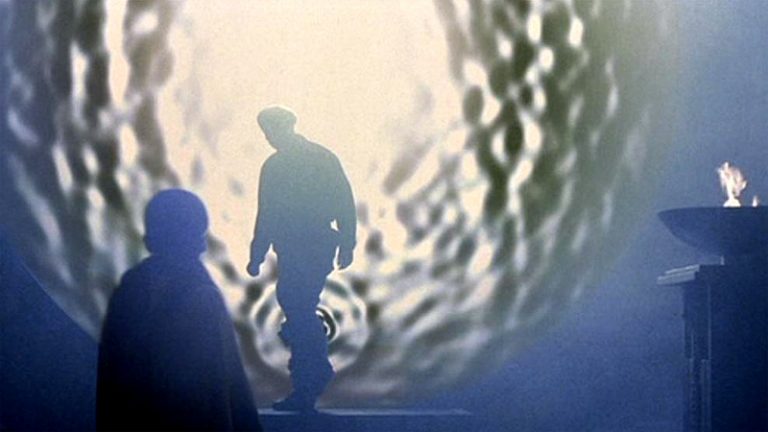
In May of 2014 MGM agreed to a feature film reboot of the franchise, helmed by Emmerich and Devlin. The two expressed joy and relief that, after a long and successful run on television (from 1997 to 2011), Stargate was finally coming back to finish the original story that its creators envisioned.
“It was taken away from us, and it’s tough to have your children raised by other parents, even if they do a very good job,” Devlin told Variety. “… For us, it’s not putting down what has been done. It’s to let us finish telling our story.”
In what they hoped would become a proper trilogy, Emmerich and Devlin intended to start from scratch with a new telling of the Stargate’s discovery. Nicolas Wright and James A. Woods were hired to write the script (having worked with Emmerich on another 1990s revival, Independence Day: Resurgence). But production languished, and Devlin expressed some unhappiness with where the story was going — and with the strictures of working within the Hollywood studio system.
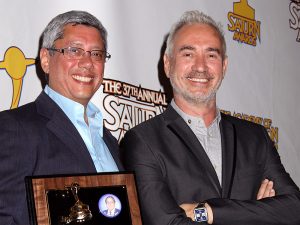
Dean Devlin and Roland Emmerich at The 37th Saturn Awards in 2011.
He excused himself from the project, and by the fall of 2016 news broke that Stargate’s return to the big screen wasn’t meant to be. The project was dead. Emmerich took another run at Stargate a few years later, but that project too failed to win a green light from the studio.
As Stargate celebrates its 30th anniversary it seems that the original creators’ vision for the Stargate universe will remain an artifact of the past — at least for now. The online retail giant Amazon purchased MGM (and Stargate) in 2022 for nearly $8.5 billion, and today the newly formed Amazon MGM Studios is still weighing what it will do next with the once mighty franchise.
Thirty years after Stargate hit theaters the film’s legacy is mighty indeed. While it has yet to reach the cultural notoriety of the likes of Star Trek (born 1966) or Star Wars (1977), the universe created by Emmerich and Devlin is one that is rich and sprawling — and still ripe for storytelling.
Only Amazon and MGM can give an answer to the question that remains — that question fans have been asking since Stargate Universe went off the air back in 2011: What story is next for Stargate … and who will tell it?
How are you celebrating the 25th anniversary of Stargate? And what do you want to see next for the franchise? Sound off below!