Stargate SG-1: “Revelations”
Years before the Marvel Cinematic Universe brought Thor, Loki, and the rest of Norse mythology into the popular imagination, Stargate SG-1 was giving its own spin on these characters. Stargate’s Asgard were little gray aliens from another galaxy, benevolent toward humans, who would become friends to SG-1 and one of Earth’s most important allies.
On the show Thor was Supreme Commander of the Asgard fleet and a friend to Earth, and Loki a genetic scientist willing to break any rule to try and save his people. Thor’s Hammer was a piece of technology that protected the planet Cimmeria from the Goa’uld, and his chariot a great Asgard battleship.
But where was Odin? As the show’s 10-year run went on the writers introduced figures like Freyr and Kvasir, Hermiod and Heimdall … but what about the king of the realm, the Allfather who was said to embody wisdom, war, and death? Maybe Odin was the leader of the Asgard civilization? Supreme Commander of the Asgard fleet (before Thor himself was given the title)? Thor’s biological dad, even?
Here’s a piece of Stargate history that I think most Stargate fans have never heard about. Yes, Stargate very nearly gave us the Asgard Odin.
This was an idea for an episode that truly would have turned the show’s mythology in a new direction. Odin was pitched to be a major villain, on the order of Sokar or Stargate Atlantis‘s Wraith-human hybrid Michael. And while the story was ultimately scrapped, nearly every element was later brought into the show in one way or another.
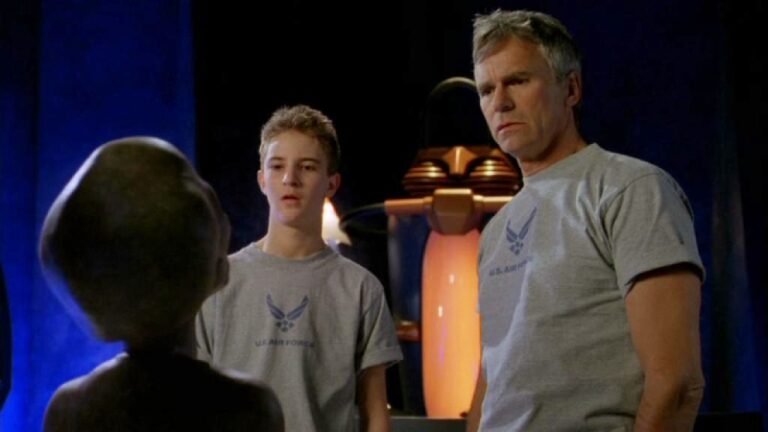
Jack O’Neill and his young clone. From “Fragile Balance”
A FRAGILE BALANCE
It was the fourth season, and things in the Stargate SG-1 production office had shifted. Series co-creator Jonathan Glassner had departed the series (holding on to a consulting producer credit), and newcomers Joseph Mallozzi and Paul Mullie had joined the writers room. Veteran director Peter DeLuise was also deepening his involvement behind the scenes, submitting story ideas and eventually writing scripts — starting with “The First Ones,” which introduced the Unas Chaka. DeLuise gravitated particularly toward Unas and Jaffa stories, helping producers to flesh-out the language in a more organized fashion.
Another occasional creative contributor was Michael Greenburg, who served as a hands-on executive producer on Stargate. Greenburg had story credits for “Message In a Bottle” and “Crystal Skull,” and now he and DeLuise teamed up to develop an ambitious new pitch.
Under the working title “Fragile Balance,” they wanted to tell a Jack O’Neill story that took his unique relationship with the Asgard in a radical new direction. But, like many great episodes, the first idea didn’t quite work.
“I wanted to do a Quantum Leap episode, which was one of the earlier [geneses] of ‘Fragile Balance,’” DeLuise told RDAnderson.com. “Old O’Neill jumps into his younger body, a la Quantum Leap. And he’s in boot camp, but then he would be affecting the time-space continuum … and then it was, well, how do you put it back? And that’s where the big fight happened about the putting it back thing. So we couldn’t resolve that issue, and it was Quantum Leap and not Stargate, so that was kind of kiboshed then.”
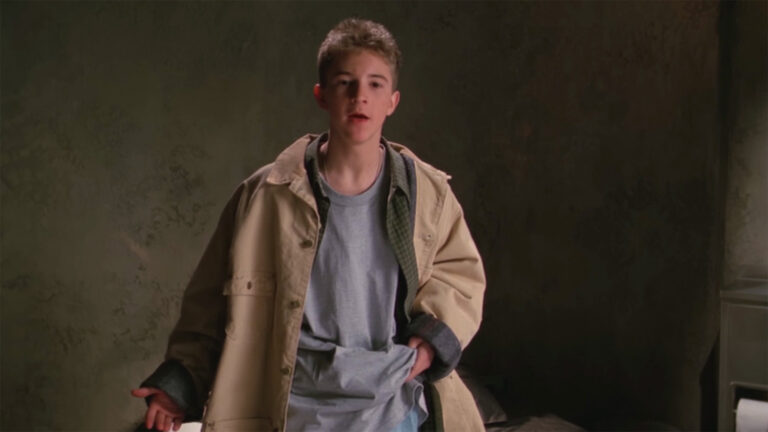
Michael Welch as a teenage clone of Jack O’Neill. From “Fragile Balance”
Going back to the drawing board, DeLuise and Greenburg considered how to do a young version of Jack, not through time travel, but now through the experimentation of a renegade Asgard. Maybe this could fit with another idea, which was the writers’ desire to explore the Asgard and why they all look so similar — something that hadn’t been examined on the show yet.
The idea now was “to attack the Asgard and their obvious physical and intellectual evolution,” Greenburg told the site. “When you look at these creatures, they have big heads, big brains, and their bodies are kind of genderless. We wanted to examine that and we came up with cloning. They were just cloning themselves and cloning themselves and cloning themselves, with the potential of the vicious cycle that that would create — and then un-create, meaning they reached a point where they couldn’t reproduce on their own.
“So they solely had to resort to cloning and the diminishing returns of that kind of continuation. So that’s what the story was about.”
Fans of the show will recognize all of this, of course: the idea that the Asgard are all clones would eventually be incorporated into the mythology. But DeLuise and Greenburg had a bigger idea to pull these threads together.
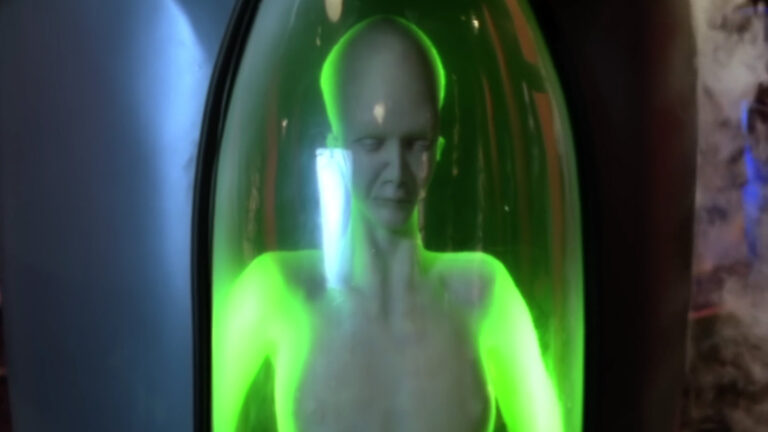
Odin was conceived to be a human-Asgard hybrid.
ENTER ODIN
Greenburg reveals that the original idea centered on the chief antagonist Odin: a half-human and half-Asgard who has gone rogue, and is out there in space on his own ship. In defiance of the Asgard High Council, Odin is experimenting on humans — and his own genetic code — to try and solve the Asgard’s cloning problem using human DNA.
And who has the most interesting DNA of them all, to an unethical Asgard scientist? Jack O’Neill, of course.
“Our antagonist in the original story was this character Odin, who was half human and half Asgard, and he was out there in this renegade ship in space,” Greenburg said. “Because of this cloning continuum that was showing diminishing returns he kidnapped O’Neill, who had the mind that they wanted to tap into, and the DNA that they wanted to tap into, to try to abate the diminishing returns of cloning.”
“Fragile Balance” even went far enough during the 2000 production year that the show’s art director Brentan Harron produced concept drawings for Odin’s ship, and a laboratory where he conducted illicit cloning experiments. In the course of the story Odin would have kidnapped Colonel O’Neill, as his chief motivation was revealed to be the effort to overcome the Asgard cloning project’s diminishing returns — a problem that inevitably would be fatal to his race.
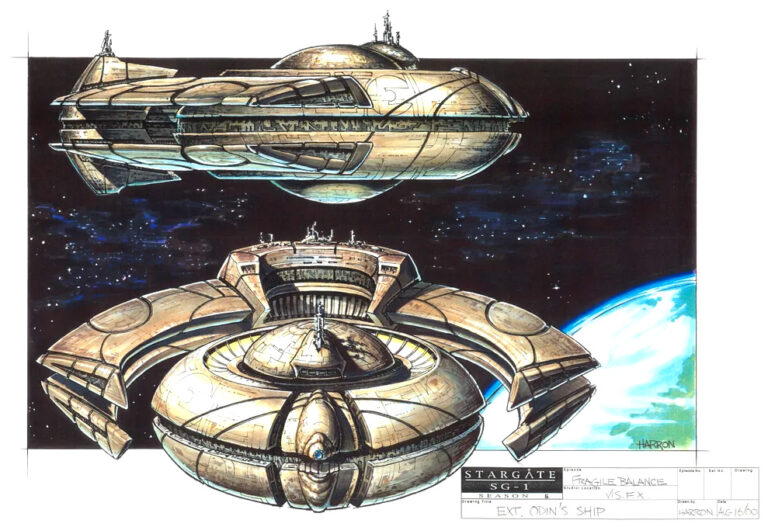
“Odin’s ship” concept art by Brentan Harron (August 2000)
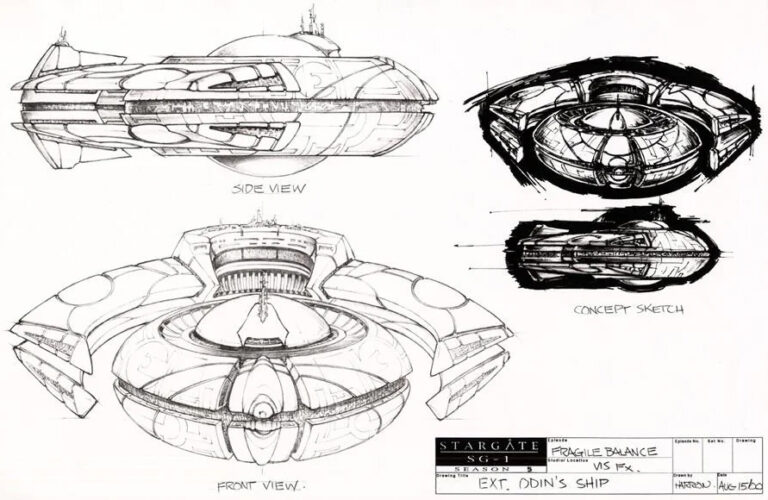
“Odin’s ship” concept art by Brentan Harron (August 2000)
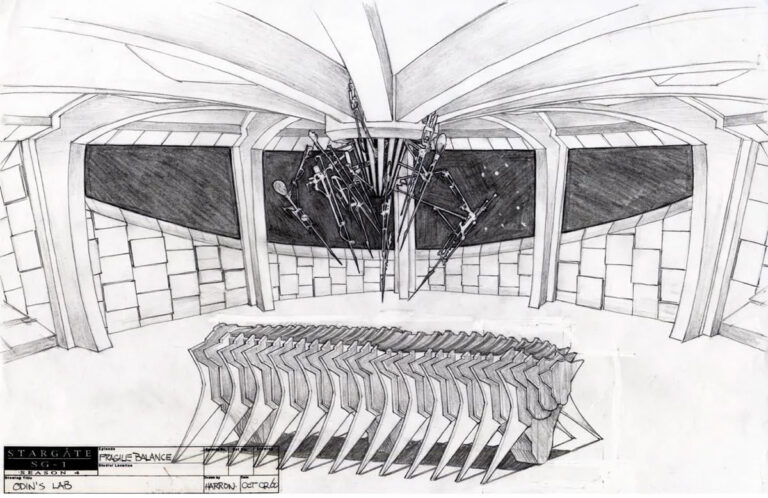
“Odin’s lab” concept art by Brentan Harron (October 2000)
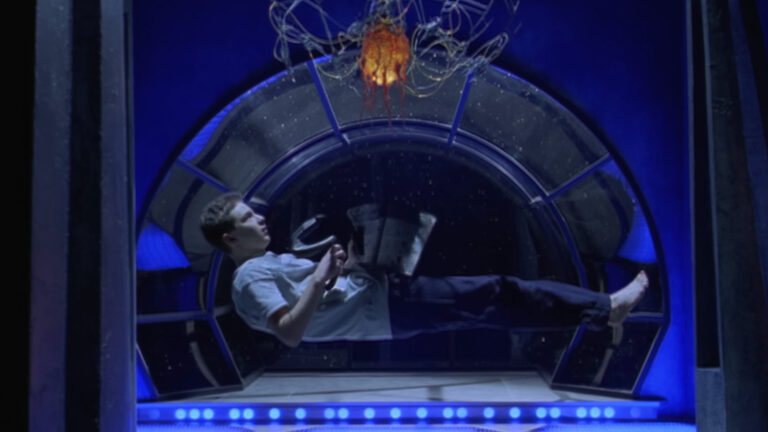
Loki’s lab as it appears in the final episode. From “Fragile Balance”
As Season Four drew to a close, however, the story wasn’t quite ready to earn a green light from the showrunner. The year’s 22 episode slots filled up, and “Fragile Balance” was pushed to Season Five.
The idea was under consideration for a slot late in that season, and even got a mention in the July 2001 special issue of TV Zone magazine. (The Season Five preview, from writer Steven Eramo, includes one line about the episode: “[‘Fragile Balance’] continues the Asgard story arc and introduces another new character to the show.”)
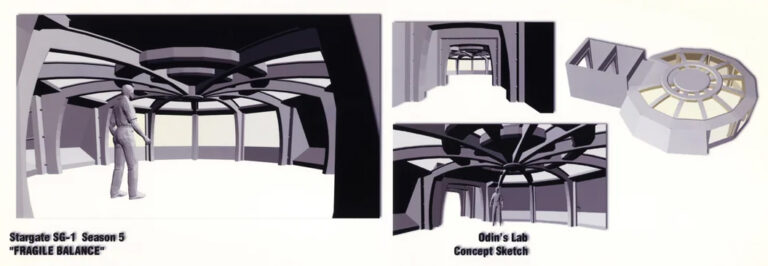
“Odin’s lab” concept art (2001)
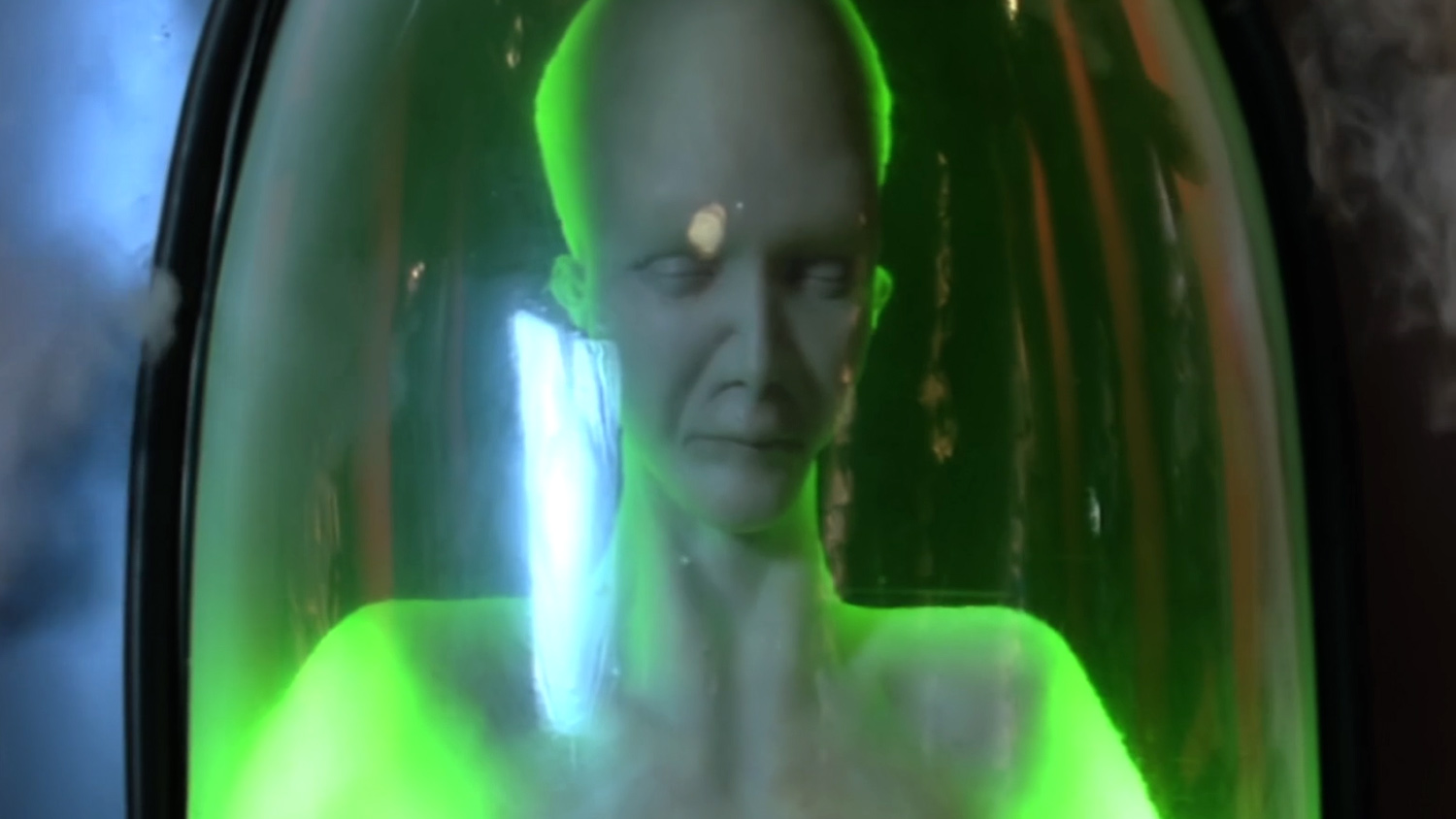
Season Five yielded additional concept art, including digital mock-ups for Odin’s lab, which would be built as a set piece at The Bridge Studios. But for reasons unknown, it seems to be at this moment that Odin himself was shelved as a villain. Key elements of the pitch were incorporated into the season finale, “Revelations” — the Asgard as clones, a scientist named Heimdall working to solve the fatal flaw in their biology, and even the discovery of a tall and very human-looking Asgard ancestor who lived 30,000 years ago.
But “Fragile Balance” was pushed again when the show was picked up for a sixth season. Would the rest of this story ever see the light of day?
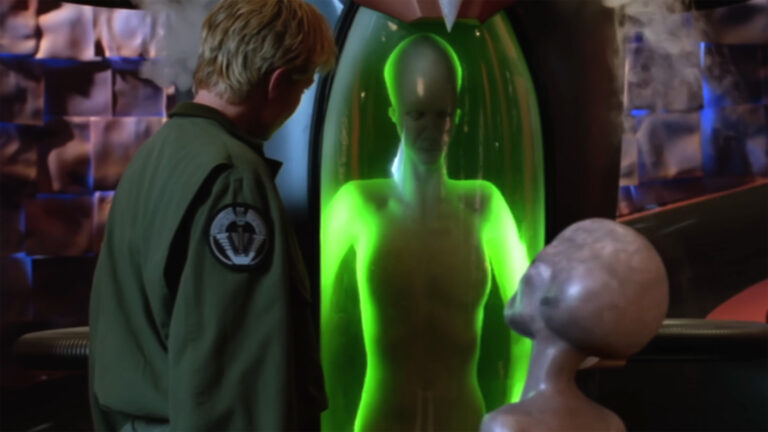
Heimdall shows Carter an Asgard ancestor. From “Revelations”
SALVAGED STORIES
Michael Greenburg was still talking about “Fragile Balance” during the 2002 production year. He told Starburst magazine (special issue #47) that it was still in the works, as production rolled along on Season Six — with the series now moving to SCI FI Channel. This would be a timely and topical story about cloning, told in a way that contemporary viewers would find relatable.
Once again, for reasons known only to the decision-makers in Stargate’s writers room, Greenburg and DeLuise’s episode did not make the cut. But its time was not far off: the show was renewed once again, and after four years of trying, in 2003 “Fragile Balance” went onto the production calendar for Season Seven, with Peter DeLuise directing. (Damian Kindler finally wrote the teleplay, with DeLuise and Greenburg sharing the story credit.)
The real-life pressures of Season Seven made the young Jack story suddenly a perfect fit. With series star Richard Dean Anderson reducing his time on set, the writers were looking for ways to tell engaging stories without their leading man. DeLuise reintroduced the idea of a young version of the character (who could be played by a different actor). He credits executive producer Robert C. Cooper for suggesting a clone who hadn’t fully matured (a significant improvement over Jack “quantum leaping” into his younger self).
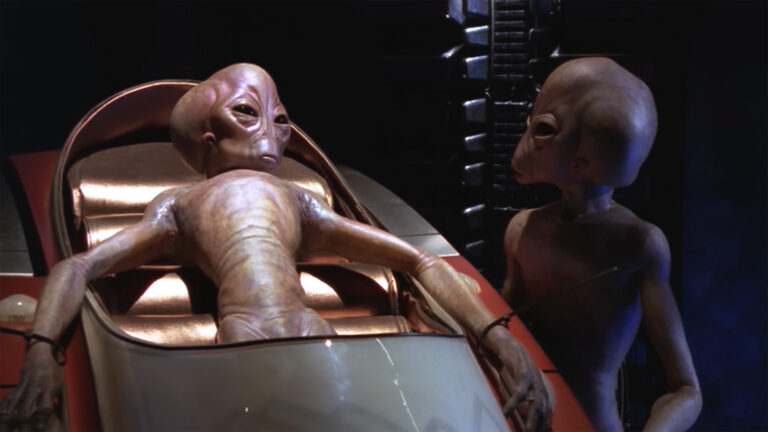
Loki gets a dressing down from Thor. From “Fragile Balance”
Stargate’s version of Odin, on the other hand, would ultimately be lost to the churn of the writers room. The Asgard would stay on the safer path as Earth’s reliable allies. But nearly all of Greenburg and DeLuise’s story pitch did make it into the show in one form or another. In the final episode the human-Asgard hybrid idea is gone, and now the Asgard who is secretly experimenting on humans is none other than Loki. Loki (voiced by Peter DeLuise) is an otherwise ordinary Asgard scientist, not evil, but who defies the High Council and conducts unsanctioned experiments on human subjects. Loki clones Jack O’Neill on board his ship in order to study his DNA, and inadvertently sends the clone back to Earth as a teenage boy.
“That was part of the genesis of the ‘Fragile Balance’ episode, the Mini Me, a younger version of O’Neill,” DeLuise said. “So we’d have the O’Neill character, but it wouldn’t be Richard Dean Anderson who was playing him.” Teen actor Michael Welch was cast in the memorable role, bringing a perfect mix of sarcasm and sympathy to the part. (A sequel pitch — titled “You Ain’t Jack” — would have paired Welch’s O’Neill with Tom McBeath’s Harry Maybourne … but never got off the ground.)
Three years after the first pitch, a whole lot of the original idea made it into the show — a young Jack O’Neill, a human-looking Asgard, cloning problems and the Asgard’s ongoing research, a renegade scientist who defies the Council, and a hidden space ship with a scary-looking laboratory for all sorts of probing.
But in the final balance, Stargate’s writers may have made the right decision by keeping the Asgard as our benevolent allies — and not introducing an aggressively creepy antagonist. Rather than exploiting human beings for their own gain, the Asgard were preoccupied with the Replicators … and their own official cloning research, which ultimately failed to save them.
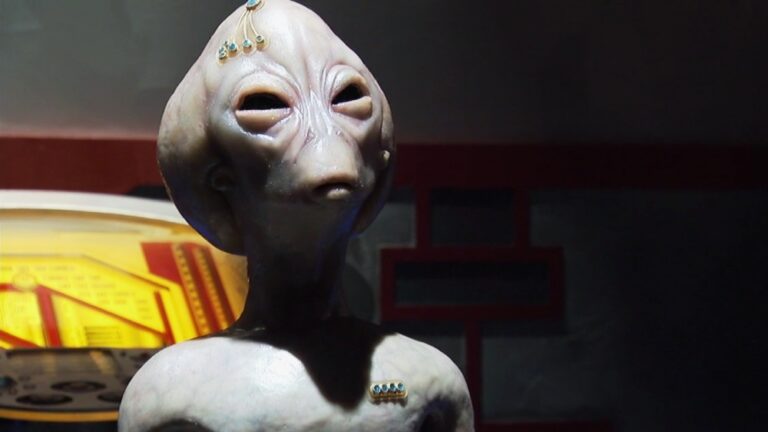
Atlantis introduced a group of rogue Asgard who had emigrated to the Pegasus Galaxy, in order to study cloning in secret. From “Lost Tribe”
The idea of using the Asgard as a powerful antagonist was so good, though, that the writers didn’t let go of it entirely: Stargate Atlantis would eventually introduce a whole colony of rogue Asgard, living in secret in the Pegasus Galaxy, who were willing to do whatever is necessary to achieve their objectives (“Lost Tribe”). While this story was cut short by the spin-off’s cancellation, the writers had every intention to bring them back as recurring villains — a major change from SG-1’s little gray buddies.
Greenburg, for his part, seems content with how the story finally turned out.
“I haven’t written that many Stargates but my experience in writing the stories is they just change,” he said. “They change for lots of different reasons. Hopefully they’re for the better. I’m pretty happy with ‘Crystal Skull’ and ‘Message in a Bottle,’ even though they’re different from their original stories. They’re still good, I like them. Maybe the originals would have been favorites too! It’s just part of the game.”
Why the Powers That Be finally chose not to introduce a hybrid Asgard villain is a mystery. But the tale of Stargate’s Odin is a reminder of the fluidity of TV production, the ways in which creative ideas bounce off each other and take new forms, until the pieces begin to fit together in a way that works for the show. And what an amazing picture Stargate finally created.
What did you think of the final version of “Fragile Balance”? Would you like to have seen an evil Asgard-human hybrid? Or is there a better way to introduce Odin into Stargate? Let’s hear it in the comments below!